









Blog
The Fountain Pen Paper Compatibility Matrix: Best Notebooks for Every Nib and Ink
Jul
Which notebook is actually safe for your fountain pen? The honest answer is not “the thickest paper” and it is not automatically “the most expensive notebook.” The result comes from a three-way match between your nib, your ink and the way the paper is sized or coated.
This guide answers the questions fountain pen users repeatedly ask in search results, notebook reviews and communities: Why does my ink feather? Is ghosting the same as bleed-through? Is 80 GSM enough? Which notebook works with a broad nib? Why does Tomoe River show magnificent sheen but take longer to dry?
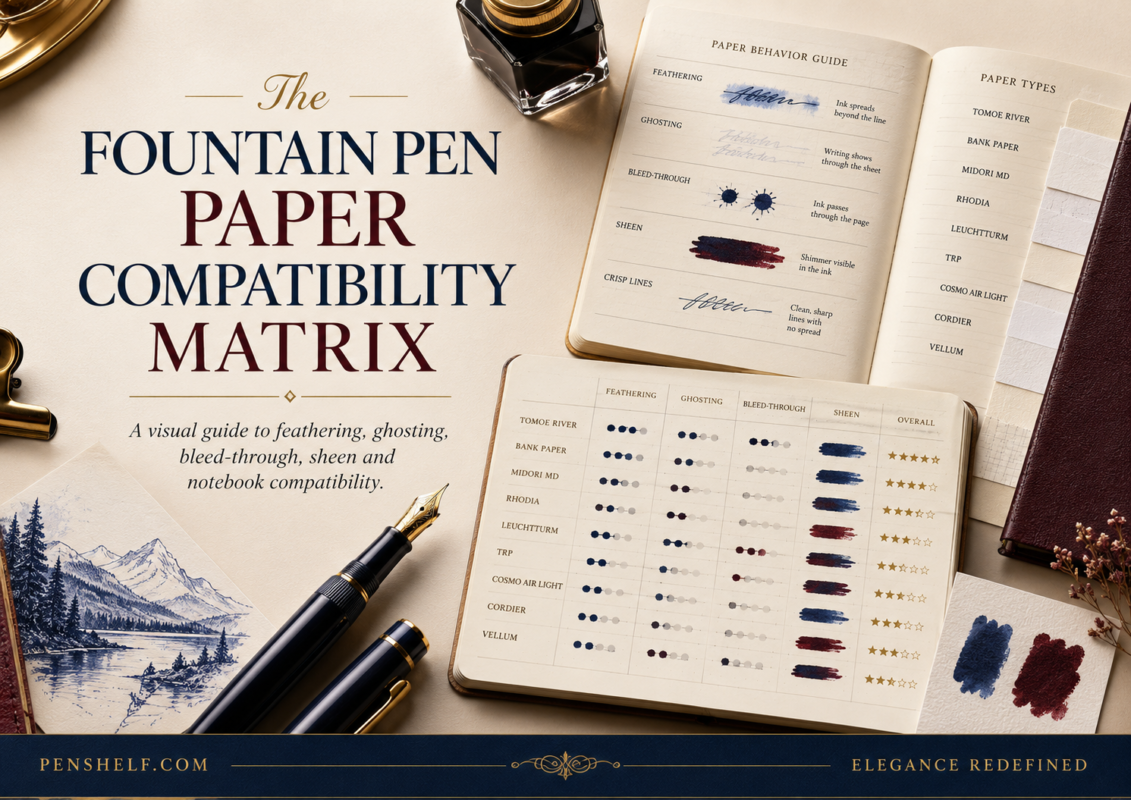
The Fountain Pen Paper Compatibility Matrix
The matrix below is a practical benchmark assembled from manufacturer specifications, specialist paper tests and repeated community experience. It is designed to help you shortlist the right paper. It is not a promise that every production batch, ink and nib will behave identically.
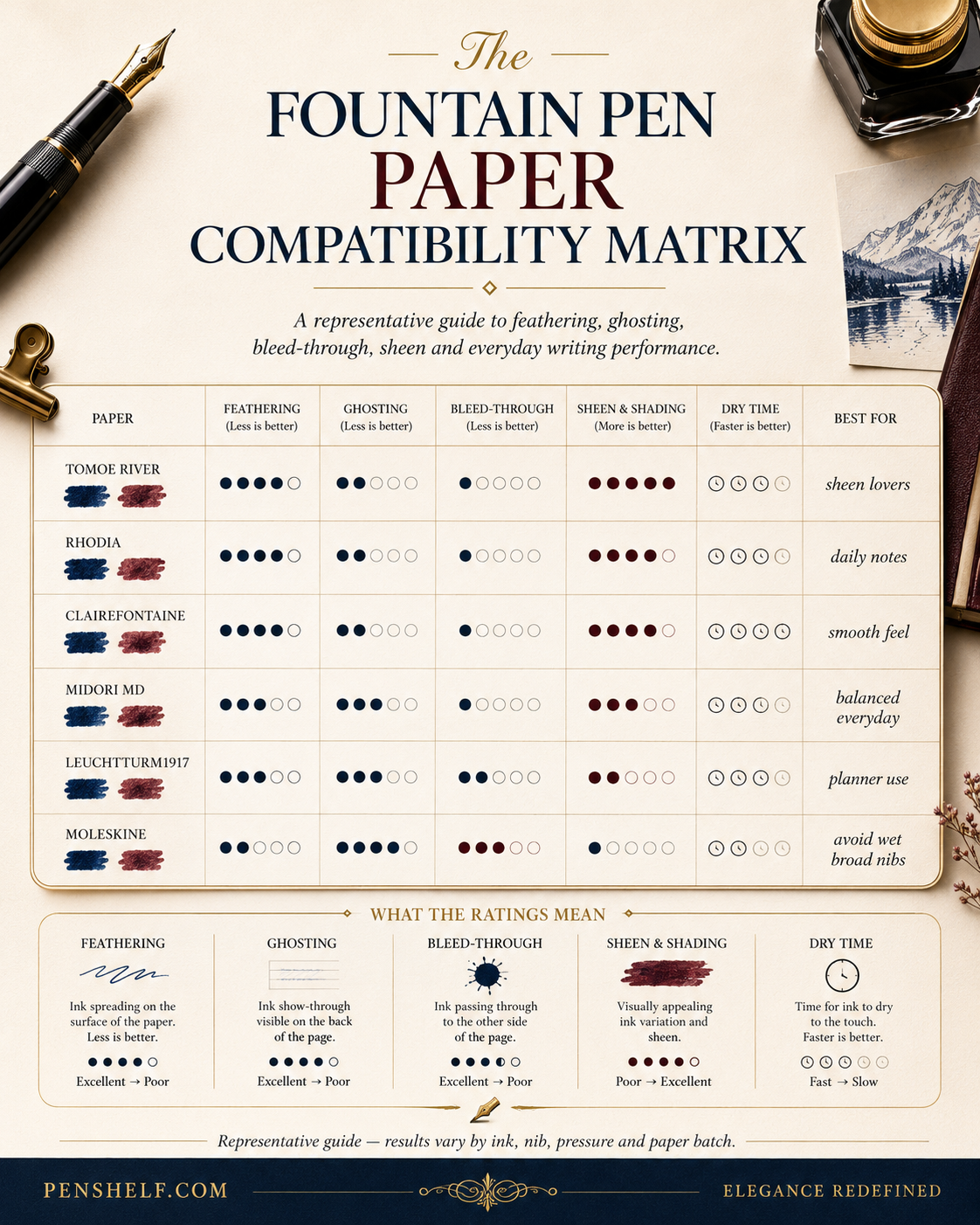
| Paper or notebook | Feather resistance | Bleed resistance | Low ghosting | Sheen & shading | Drying speed | Best match | Main compromise |
|---|---|---|---|---|---|---|---|
| Tomoe River S 52 gsm | ★★★★★ | ★★★★★ | ★★☆☆☆ | ★★★★★ | ★☆☆☆☆ | Sheening inks, ink journals, compact high-page-count planners | Visible ghosting and slow dry time |
| Rhodia 80–90 gsm | ★★★★★ | ★★★★★ | ★★★★☆ | ★★★★☆ | ★★☆☆☆ | Daily notes, testing pens, smooth writing | Slick surface can slow drying |
| Clairefontaine 90 gsm | ★★★★★ | ★★★★★ | ★★★★★ | ★★★★☆ | ★★☆☆☆ | Broad nibs, correspondence, users who want a glassy feel | Very smooth paper offers little feedback |
| Midori MD | ★★★★★ | ★★★★★ | ★★★★☆ | ★★★★☆ | ★★★☆☆ | Journaling, letters and writers who enjoy tactile feedback | More texture than Rhodia or Clairefontaine |
| Leuchtturm1917 80 gsm | ★★★★☆ | ★★★★☆ | ★★★☆☆ | ★★★☆☆ | ★★★☆☆ | Planning, indexing and ordinary Fine/Medium nib use | Ghosting is visible; very wet combinations need testing |
| Leuchtturm1917 120G | ★★★★★ | ★★★★★ | ★★★★★ | ★★★☆☆ | ★★★☆☆ | Two-sided writing, sketching and wet nibs | Fewer pages and a heavier notebook |
| Maruman Mnemosyne | ★★★★★ | ★★★★★ | ★★★★☆ | ★★★☆☆ | ★★★★★ | Fast office notes and many left-handed writers | Less dramatic sheen than Tomoe River |
| Kokuyo Campus | ★★★★☆ | ★★★★☆ | ★★★★☆ | ★★☆☆☆ | ★★★★☆ | Value-focused study notes and Fine/Medium nibs | Not primarily an ink-showcase paper |
| Apica Premium C.D. | ★★★★★ | ★★★★★ | ★★★★☆ | ★★★★☆ | ★★★☆☆ | Premium everyday writing and smooth Japanese paper | Availability and price can vary |
| Moleskine Classic | ★★☆☆☆ | ★★☆☆☆ | ★★★☆☆ | ★☆☆☆☆ | ★★★★☆ | Fine dry nibs after a pen test | Batch variability; feathering and bleed-through with wetter pens |
How to read the stars: five stars means the paper is normally strong in that category. For drying speed, five stars means faster. Ratings are directional rather than laboratory measurements. Fountain pen results vary with ink chemistry, nib wetness, writing pressure, hand oils, humidity and paper batch.
There is no single “best paper for fountain pens”
A paper can be excellent at preventing feathering and still be a poor choice for a left-handed writer because the ink remains wet. Another paper can dry rapidly but flatten the shading and sheen that made you buy a special ink. Thin paper can outperform thick paper because its surface sizing prevents liquid ink from entering the fibres.
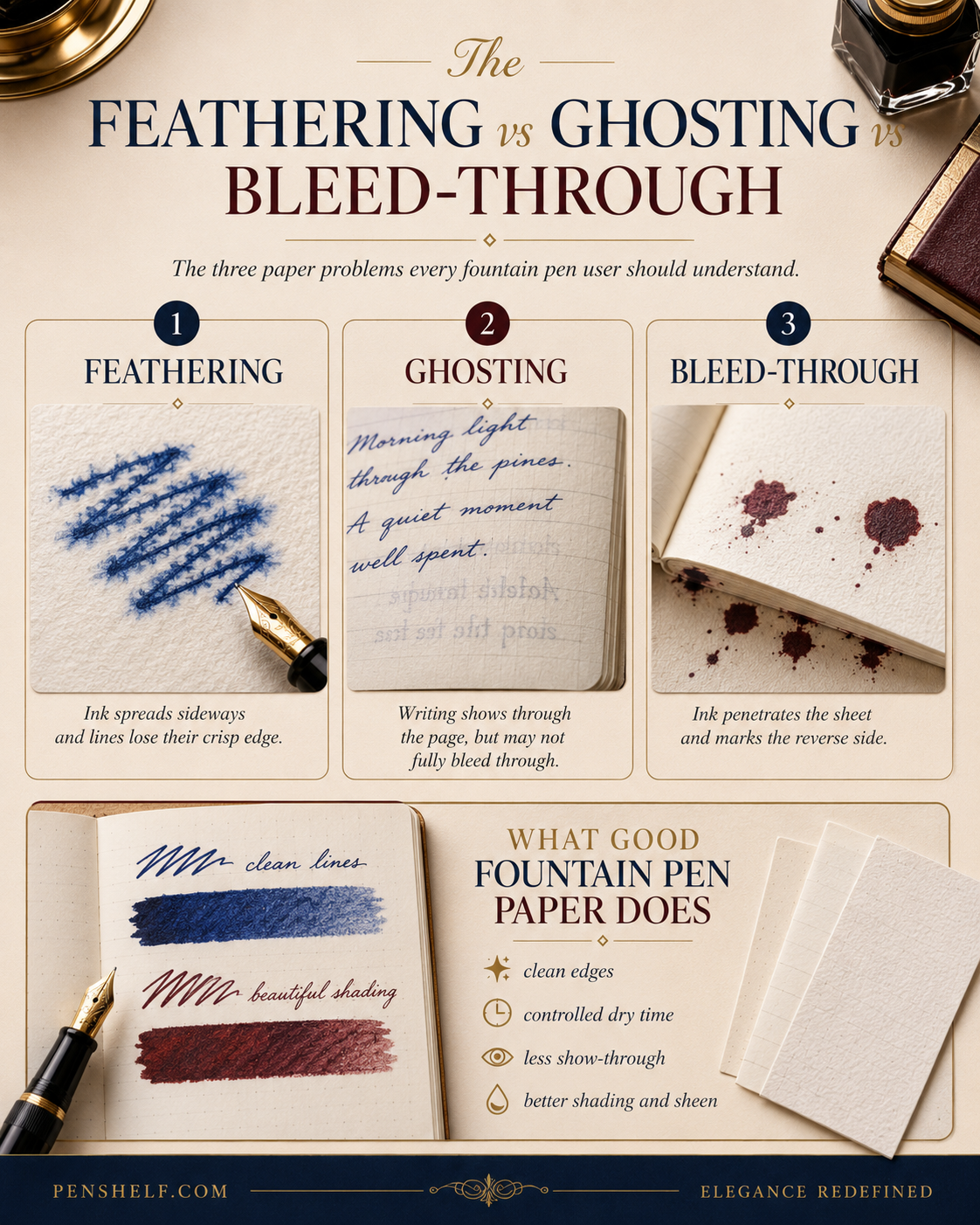
Feathering vs ghosting vs bleed-through
Feathering
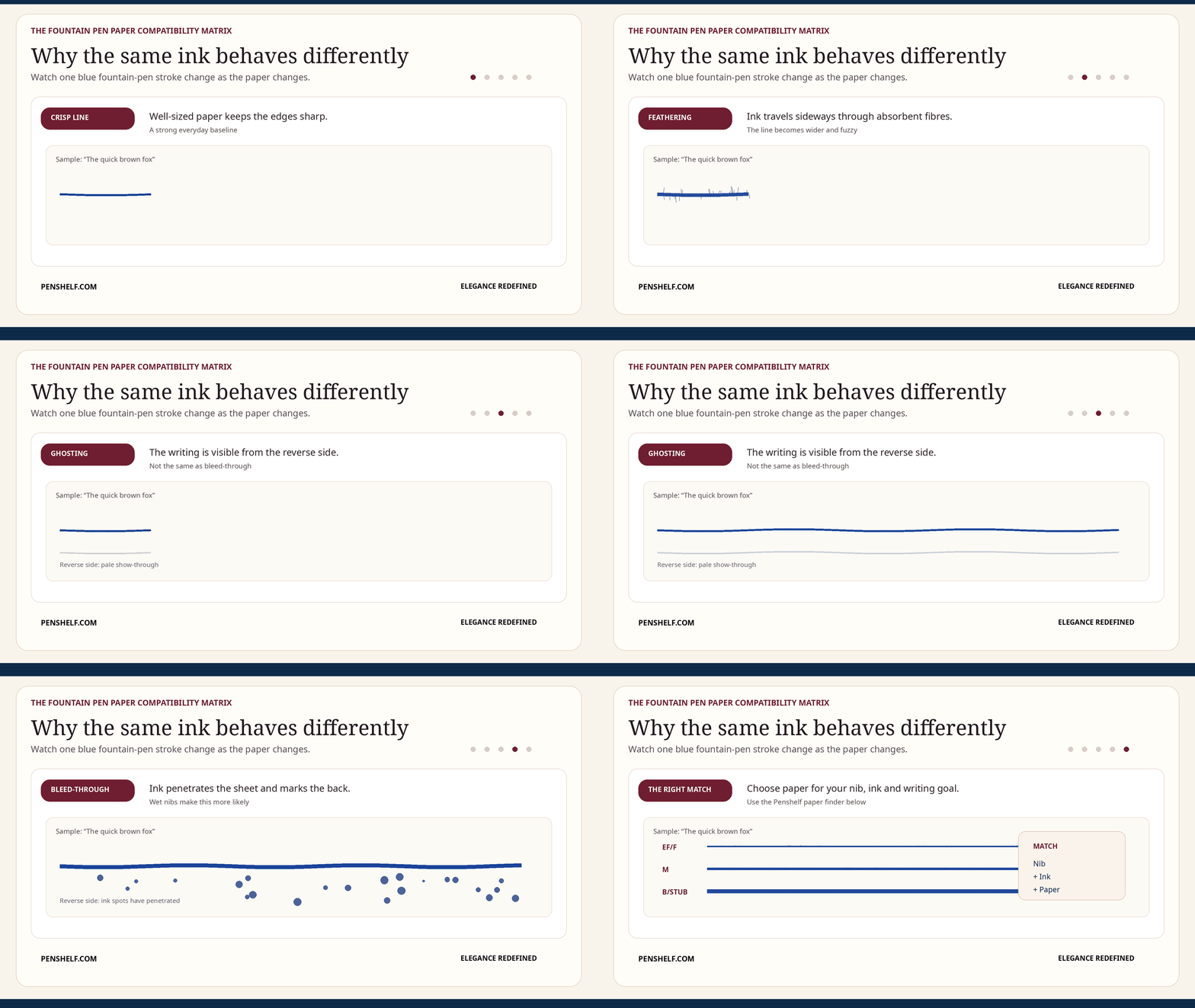
Feathering is sideways spread. Tiny ink veins escape from the intended line through the paper fibres, making handwriting look fuzzy. It is most visible with wet inks, broad nibs and absorbent office paper. A finer or drier combination can reduce it, but genuinely fountain-pen-friendly paper should control normal everyday nibs without forcing you to change your handwriting.
Ghosting
Ghosting, also called show-through, means the writing is visible from the back because the sheet is thin or translucent. The ink has not necessarily penetrated the sheet. Tomoe River is the classic example: it can resist actual bleed-through remarkably well while still showing substantial ghosting because the paper is extremely thin.
Bleed-through
Bleed-through means ink has entered or crossed the sheet and left marks on the reverse side. This is the issue that prevents comfortable two-sided writing. It can appear as isolated dots at slow strokes, intersections and flexed downstrokes before it affects an entire line.
Notebook-by-notebook guide
Tomoe River S: best when the ink is part of the experience
Tomoe River remains the reference point for people who buy ink specifically for shading, halo, shimmer and sheen. Specialist comparisons repeatedly place it among the strongest ink-showcase papers. The trade-off is simple: a non-absorbent surface gives dye time to pool, and that same behaviour produces slower drying. Thin sheets also show the writing from the back.
Choose it for: ink journals, Hobonichi-style planners, fine writing with many pages, and enthusiasts who want every property of an ink to appear. Avoid it when: you are a side-writing left-hander, turn pages immediately, or strongly dislike ghosting.
Rhodia: the dependable everyday benchmark
Rhodia is often the safest first upgrade from generic office paper. It is smooth, predictable and forgiving across nib sizes. Community comparisons often describe Rhodia as the day-to-day option and Tomoe River as the more specialised, “precious” ink-display option.
Choose it for: office notes, pen testing, calligraphy practice and people who want low feathering without the extreme thinness of Tomoe River. Watch for: smearing when a wet ink sits on the smooth surface.
Clairefontaine: smooth, substantial and excellent for broad nibs
Clairefontaine identifies its well-known vellum notebook paper as 90 gsm. The denser, very smooth surface normally gives strong resistance to both feathering and bleed-through. It is an excellent candidate when a Broad, Stub or wet Medium nib overwhelms ordinary notebook paper.
Choose it for: correspondence, signatures, wet nibs and users who enjoy minimal feedback. Avoid it when: you prefer a textured page or need the fastest possible drying.
Midori MD: controlled feedback for journaling
Midori MD is popular with writers who find highly coated paper too slippery. The nib remains controlled and the paper still handles fountain pen ink well. This makes it particularly attractive for long-form journaling, where tactile feedback can improve handwriting rhythm.
Choose it for: letters, diaries, reflective writing and Fine-to-Medium nibs. Watch for: visible texture and moderate ghosting depending on ink load.
Leuchtturm1917: choose the paper version, not only the cover
The standard 80 gsm notebook is practical because it combines numbering, indexing and many pages, but some ghosting is normal. The official 120G Edition uses 120 g/m² paper, has very low transparency and is designed to retain a clear stroke outline. It is the better choice for wet inks and writers who need both sides of every page.
Choose 80 gsm for: planners and ordinary Fine/Medium combinations. Choose 120G for: low ghosting, sketching and wetter pens.
Maruman Mnemosyne: a strong fast-note option
Paper that dries quickly does not always display the strongest sheen, but it can be the right answer for meetings, lectures and left-handed writing. Specialist comparisons regularly position Mnemosyne as a fast-drying mainstream option while still controlling fountain pen ink.
Moleskine: test the exact notebook before committing
Moleskine is admired for format and design, but fountain pen users frequently report inconsistent results, particularly with wet nibs. Some Fine and dry combinations may be acceptable; Medium, Broad, Stub and flex pens can produce feathering or bleed-through. Use the final pages as a test area before writing something important.
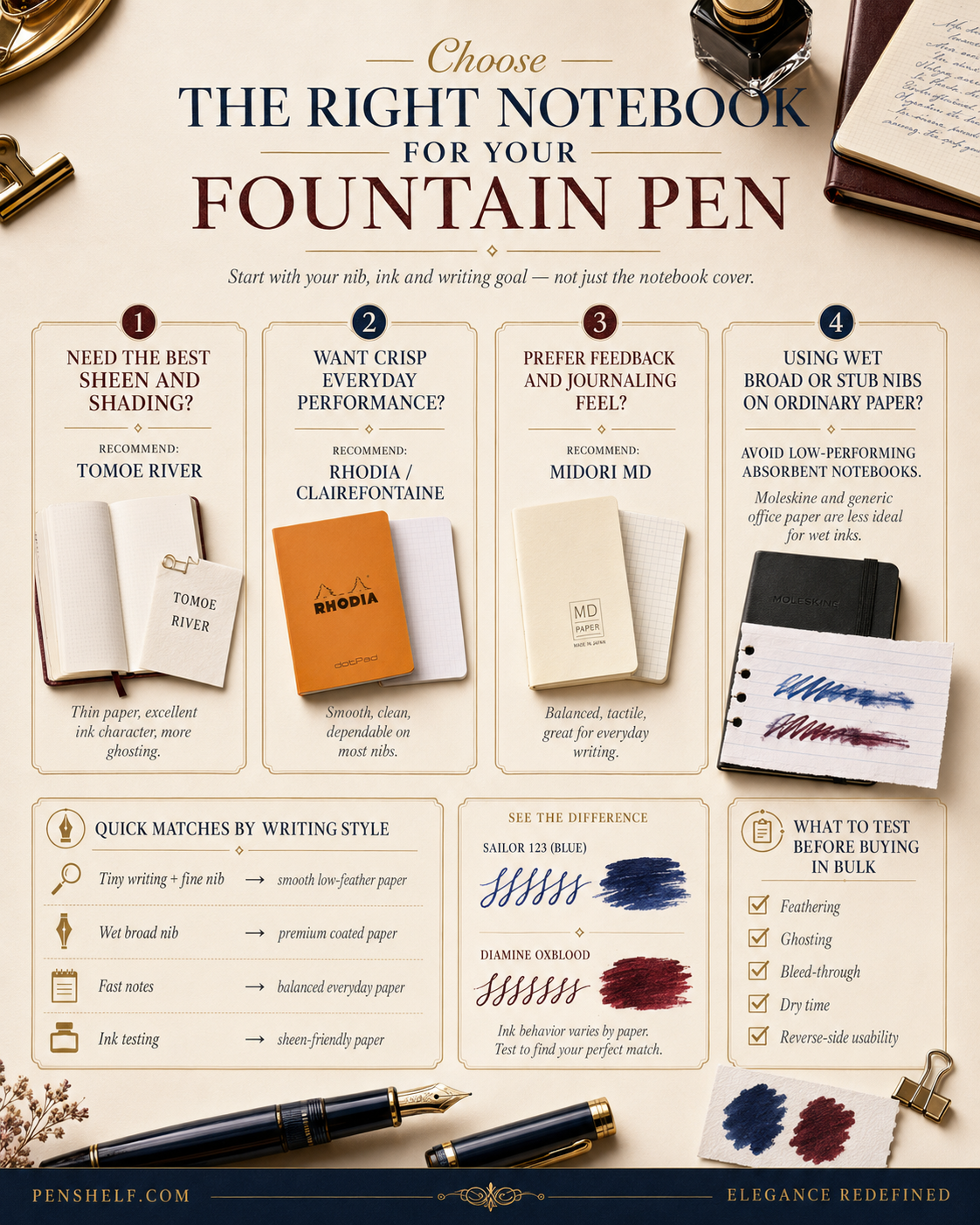
Choose paper by nib and ink—not by notebook reputation
| Your combination | Safest starting papers | What to watch | Better adjustment if it fails |
|---|---|---|---|
| Japanese EF/F + dry ink | Kokuyo Campus, Leuchtturm 80 gsm, Rhodia, Midori MD | Feedback may become pronounced on rough paper | Choose a smoother surface before changing nib size |
| Western Fine/Medium + standard ink | Rhodia, Midori MD, Clairefontaine, Apica | Dry time on highly smooth paper | Use a blotter or a moderately absorbent notebook |
| Wet Medium/Broad + saturated ink | Clairefontaine, Rhodia, Leuchtturm 120G, Tomoe River | Smearing and ghosting | Prioritise surface control and allow more drying time |
| Stub/Italic + shading ink | Tomoe River, Rhodia, Clairefontaine, Midori MD | Heavy intersections may bleed on weak paper | Use a premium sized paper and test downstrokes |
| Flex nib + wet flow | Leuchtturm 120G, Clairefontaine, selected Rhodia papers | Railroaded lines are not the paper’s fault; bleed may occur at flex points | Test slow saturated downstrokes before buying in bulk |
| Left-handed side/overwriter | Mnemosyne, Kokuyo, faster-drying everyday papers | Tomoe River and slick coated papers may smear | Pair Fine nibs with quicker-drying inks |
Find your best paper in under a minute
The interactive finder weighs nib width, ink wetness, writing purpose, your main paper concern, two-sided use, preferred writing feel, paper colour and budget. It then displays a visual recommendation and two Penshelf shopping links.
Find your fountain pen paper
No answer is selected automatically. Complete all eight questions.
Select all eight answers to unlock your recommendation.
How to test a notebook in 60 seconds
- Use the pen you will actually carry. A dry Extra Fine test tells you little about a wet Broad nib.
- Write a fast sentence and a slow sentence. Slow strokes deposit more ink.
- Add several crossed lines. Intersections reveal bleed-through earlier.
- Draw a filled square. This exposes feathering, pooling and drying behaviour.
- Wait 5, 10 and 20 seconds. Swipe a clean finger or blotter across separate samples.
- Check the reverse side under normal light. Separate ghosting from actual ink penetration.
- Repeat after touching the page. Hand oils can change how coated papers accept ink.
Questions fountain pen users ask most often
What is the best paper for fountain pens?
Is 80 GSM paper good for fountain pens?
What is the difference between ghosting and bleed-through?
Why does fountain pen ink feather?
Which paper shows fountain pen ink sheen best?
Is Rhodia or Tomoe River better?
Does Leuchtturm1917 work with fountain pens?
Can I use a fountain pen in a Moleskine notebook?
What paper is best for left-handed fountain pen users?
What paper is best for broad and stub nibs?
Share or embed the compatibility matrix
Reviewers, stationery communities and notebook sellers may reproduce the matrix image when they keep the credit and link back to this guide.
Methodology and limitations
This edition is a synthesis rather than a claim that Penshelf physically tested every notebook batch shown. The matrix uses published manufacturer specifications, specialist tests and recurring user reports. Paper production changes, regional products and batch variation can alter the result.
Why the same ink behaves differently?